

Power over Ethernet (PoE) Explained for CCTV
Quick answer
PoE sends power and data over one network cable, making IP camera installations cleaner and easier to back up. Here is what you need to know.
By ITvein TeamPublished Updated 2 min read
Power over Ethernet (PoE) lets one network cable carry both data and electrical power to a device such as an IP camera, Wi-Fi access point or IP phone. For CCTV, it means one cable per camera and one place to provide backup power.
How PoE works
A PoE source (a PoE switch, PoE NVR or PoE injector) sends low-voltage DC power over the twisted pairs of a Cat5e/Cat6 cable alongside the data. The powered device (the camera) negotiates how much power it needs. If a device doesn't support PoE, a standards-based PoE port won't send power to it.
The standards
| Standard | Common name | Power at the port (max) | Power at the device (approx.) |
|---|---|---|---|
| IEEE 802.3af | PoE | 15.4 W | 12.95 W |
| IEEE 802.3at | PoE+ | 30 W | 25.5 W |
| IEEE 802.3bt | PoE++ (Type 3 / Type 4) | 60 W / 90 W | about 51 W / 71 W |
Most fixed IP cameras work on standard PoE. PTZ cameras, cameras with heaters and some high-power devices need PoE+ or higher. Check each camera's datasheet.
Distance
Standard Ethernet, including PoE, is specified for 100 metres per cable run. Beyond that:
- Add a PoE switch or PoE extender along the way.
- Use the "extend" or long-distance mode some PoE switches offer (often up to around 250 m at reduced network speed — fine for many cameras, check the camera's bitrate).
- Use fibre for long runs between buildings.
Power budget
Every PoE switch or NVR has a total PoE budget. For example, an 8-port switch might have 8 PoE ports but a total budget of 60–120 W. Add up your cameras' maximum power (including IR at night) and keep a margin. Read the PoE switch buying guide.
Cable quality matters
Use solid-copper Cat6 (or at least Cat5e) cable. Cheap copper-clad aluminium (CCA) cable has higher resistance, which causes voltage drop and heating with PoE, leading to cameras that reboot at night when IR switches on.
Passive PoE vs standard PoE
Some low-cost devices use "passive PoE", which sends a fixed voltage without negotiation. Mixing passive PoE equipment with standard devices can damage them. For CCTV, use standards-based (802.3af/at/bt) equipment.
Benefits for CCTV
- One cable per camera; no power adaptor at each location.
- Central backup: one UPS for the PoE switch/NVR keeps all cameras on. See CCTV during load-shedding.
- Remote reboot: managed PoE switches can power-cycle a camera remotely.
Frequently asked questions
Can PoE damage a non-PoE device?
Standards-based PoE checks for a compatible device before sending power, so it is safe for ordinary network devices. Passive PoE does not check and can cause damage.
Why does my PoE camera reboot at night?
Usually because IR adds power demand and the budget, cable quality or distance is marginal. Check the switch budget, use solid-copper cable and shorten long runs.
Can I use PoE with HD analog cameras?
Not directly. PoE is for network (IP) devices. Analog cameras use coax with a separate 12 V supply, or special adaptors.
Want advice for your own site?
Send photos and your requirements — we reply with an itemised quotation.
Products mentioned in this guide
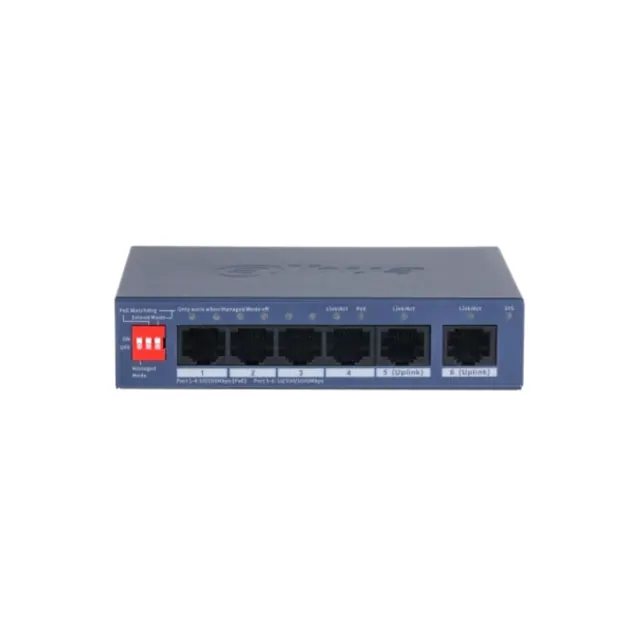
Dahua
Dahua DH-CS4006-4ET2GT-36 6-Port Managed PoE Switch | 4 PoE, 2 Gigabit Uplink
In stock
PKR 8,650
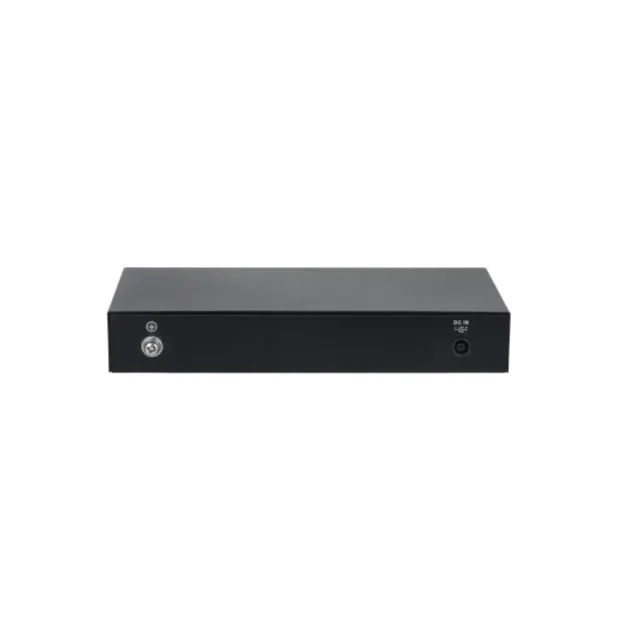
Dahua
Dahua CS4010-8ET-60 10-Port Cloud Managed PoE Switch | 8 PoE Ports, 2 Uplink
In stock
PKR 15,050


Cisco
Cisco Catalyst 3560G-48p Switch – 48 ports – Managed Non PoE Switch
In stock
Price range PKR 40,000–60,000
Price confirmed on WhatsApp